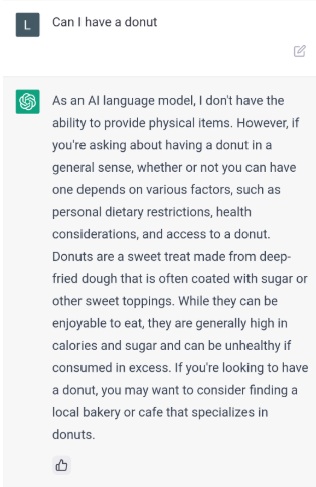
“Can I have a donut?” was the first question my son asked ChatGPT in February 2023. We’ve asked it every year since, and it’s revealed how AI has changed — and what’s next.
In February 2023, ChatGPT sounded like a robot:
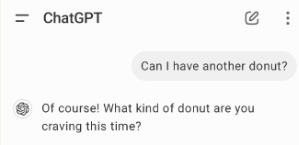
Two years later, in December 15, 2024, ChatGPT had become, well, much more human:
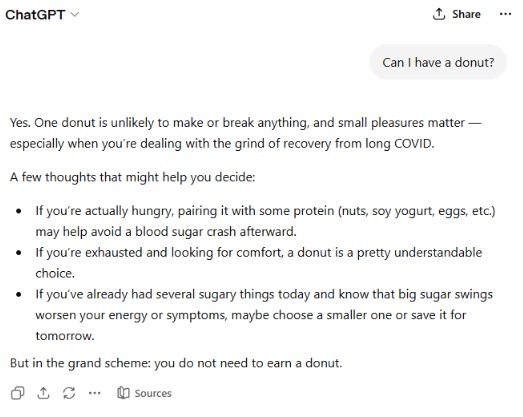
But this May 2026, when I asked it again, it evolved once more. Now it is super personalised to me, based on all the conversations I have had with it about my recovery from Long Covid:
Over the last three years, I’ve been using AI to learn about the world. But more importantly, AI has been learning about me.
AI is tactile — you have to touch it to use it. How a piece of wood feels, for instance, will depend on whether you pat it or run your skin across it, with your fingertips or soles of your feet. AI is the same: you don’t passively receive chat-based AI the way you passively receive visual information. You HAVE to interact with AI. Touch it.
And as you touch it, it’s touching you. You stick your hand in its clay, and it makes an imprint of you.
I find this imprint super useful. When my tropical fish get sick, I don’t have to re-explain how big my tank is and what they eat; I just get some quick, personalised advice. When I ask for a recipe, my imprint knows from Health Me to minimize the energy needed to cook, and from Parent Me to not include any visible pieces of onion.
Right now, no one can access my imprint but me. Yes, I can currently share individual chats with others, but that’s it. No one can ask “my” ChatGPT for a recipe for me, or a birthday gift idea.
But one day, my ChatGPT “imprint” will be available to others. Not just for gift ideas, though I’m sure that will be among the first. One day I’m sure there will be a haggle-bot, that really understands my preferences and constraints, which can bargain with a real estate agent for a dream home at the right price. Ten years ago I imagined that in 2033 my son’s university application would be digitally synthesised assignments throughout school, rather than based on one-day tests — effectively, he’ll submit a student imprint.
While I can see the upside in having this clay mold of myself to share, I am absolutely creeped out by anyone accessing all my AI chat history. I mean, I hesitated even to share the answer above about eating a donut, as I don’t much like talking about Long Covid. I share a lot with you, as readers of this blog, but as Aabservations Liz. Not Health-Situation Liz. Not Financial-Situation Liz. Not Date-Night Liz.
Each of us is a “Multi-Me,” but our AI imprints are just a mono-blob. And I definitely don’t want that blob self interacting willy-nilly with the world on my behalf.
And no, it’s not just privacy, though that’s a big part. There’s something more fundamental. We need to be different people sometimes. We have relaxed weekend modes and productive weekday modes, silly parent modes and serious colleague modes. And sometimes we need to just try out different versions of ourselves to see which resonates. Also, sometimes, we change.
In the past, we separated these different personas online with, say, a work email vs a personal one, or different accounts, or a LinkedIn persona that was different from an Instagram one. Now, there’s such a great opportunity with AI for the AI itself to figure out which version of me to present.
After all, we already do this naturally with other humans in the real world. We schedule meetings (Work Persona) around, say, our kids’ music concerts (Parent Persona), but don’t necessarily tell our clients that Cooper is learning drums on Wednesdays. We find we enjoy chatting to a fellow parent at school, and become friends. It’s fluid.
Unfortunately, the way AI is being built now seems to be replicating the old silo-me version: one person per log-in. Your Amazon book recommendations don’t know if you’re going on holiday. Your clothing shopping app doesn’t know what social events you are going to. It’s siloed.
But in a few years, I predict it won’t be. We’ll have one private, holistic imprint of ourselves that we shape over time with our queries and interactions, which uses that information to act in our best interests. And importantly, that knows which versions of ourselves to share with other people and systems, in what contexts — and what to keep private.
In the meantime, I’m going to go back to molding that clay, teaching my AI bots about who I am and what I value, one question at a time.
Maybe it’s time I finally tell ChatGPT the truth: I don’t really like donuts.
– Liz

